When it comes to long-range shooting, a few environmental factors carry significantly more weight than others in calculating a firing solution. If you’re shooting 600 to 1,200 yards or beyond, understanding these factors and using the right inputs is the difference between a hit and a miss.
Factors That Affect Bullet Drop (Ranked by Impact)
- Gravity
A constant, predictable force pulling the bullet down. It never changes, but your job is to calculate how much it affects your shot over distance. - Wind
Wind is one of the most variable and challenging elements. It can push your bullet significantly off course, especially beyond 500 yards, and it changes with terrain, altitude, and time. - Air Density / Station Pressure
This is the big one—and it includes three key sub-factors:
- Station Pressure (Ambient Pressure): The real atmospheric pressure at your exact location.
- Temperature: Warmer air is less dense, meaning your bullet will fly flatter.
- Altitude: Only matters because it affects station pressure.
These three combined determine the amount of drag on your bullet and directly affect its flight path.
- Muzzle Velocity
Higher velocity means less flight time, which means less drop and less wind drift. Know your chrono data. - Ballistic Coefficient (BC)
Higher BC bullets slice through air better and retain velocity longer. Essential for precision beyond 600 yards. - Humidity
Affects air density slightly, but not a huge factor unless shooting at extreme distances or in very humid environments.
Most Shooters Are Using the Wrong Pressure Input
Let’s talk about one of the most common mistakes in long-range shooting: using barometric pressure in your ballistic calculations.
You’ve probably seen “barometric pressure” listed in your favorite weather app or maybe even on a Kestrel. Most shooters will punch it in and move on. But here’s the thing: barometric pressure is not what your bullet is actually flying through.
What Is Barometric Pressure?
Barometric pressure (BP) is the atmospheric pressure adjusted to sea level. It’s useful for meteorologists and pilots who need to compare pressure from city to city regardless of elevation. But for shooters, it’s a false reading.
If you’re shooting at 6,000 feet and enter barometric pressure say 29.92 inHg you’re telling your calculator that the air is as dense as it would be at sea level. It’s not. Your bullet is flying through thinner, high-elevation air. That sea-level fudge factor throws off your drop data and your bullet will hit low because you’re overcorrected for drag.
What You Should Be Using: Station Pressure
Station pressure (or ambient pressure) is the actual, unadjusted pressure at your current altitude. No corrections, no sea-level assumptions, just raw, real-world data. This is the pressure your bullet feels, and it’s what should go into your calculator.
Unless you’re shooting below 1,000 feet elevation, using barometric pressure will produce an inaccurate firing solution. It won’t be wildly off, but at 800+ yards, “good enough” doesn’t cut it.
How to Get Station Pressure
Here are a few ways to get the right data:
- Use a Kestrel (might use the term “absolute pressure”) or advanced weather meter that reports station pressure directly.
- Use a ballistic app that accepts elevation as an input and automatically converts barometric pressure to station pressure.
- Use a GPS-enabled device that gives you ambient pressure readings.
- As a backup, refer to a Standard Station Pressure by Elevation chart (below). It’s not perfect, but it’s closer than using B.P.
Standard Station Pressure by Elevation
| Elevation (ft) | Station Pressure (inHg) | Station Pressure (hPa) |
| 0 ft | 29.92 inHg | 1013.25 hPa |
| 1,000 ft | 28.86 inHg | 977.89 hPa |
| 2,000 ft | 27.82 inHg | 942.88 hPa |
| 3,000 ft | 26.82 inHg | 909.19 hPa |
| 4,000 ft | 25.84 inHg | 876.74 hPa |
| 5,000 ft | 24.89 inHg | 845.48 hPa |
| 6,000 ft | 23.98 inHg | 815.43 hPa |
Legendary Marine Corps Scout Sniper Carlos Hathcock used weather reports and forecasted pressure because that’s all he had at the time. You’ve got more tools; use them.
Your bullet is flying through real air, not theory. If you’re serious about long-range accuracy, you need to feed your calculator the real environmental data your bullet is experiencing.
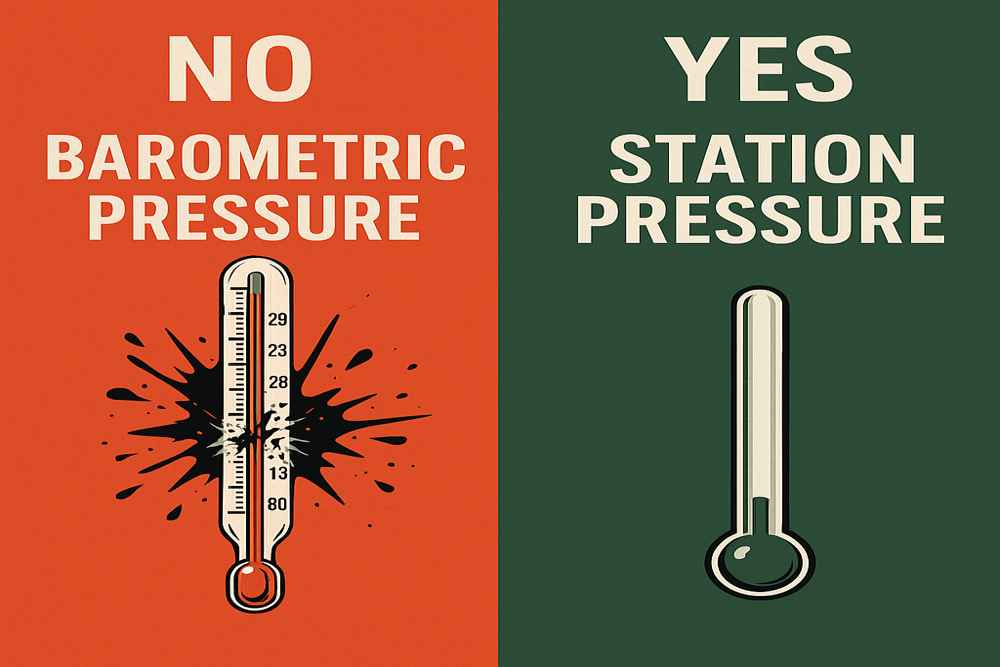
Barometric pressure is for weather apps.
Station pressure is for shooters.
Use the right data. Hit your target.
—Hi Line Tactical