Why Your Firearm Needs a Light
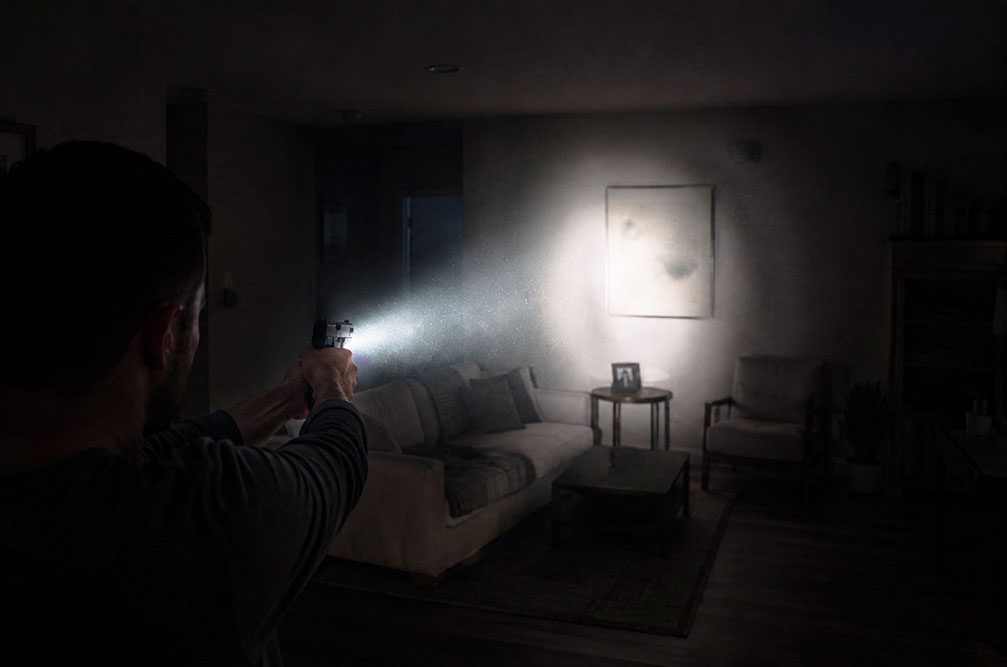
We here at Hi-Line Tactical are huge advocates of mounting lights on nearly every firearm you own. Your hunting rifle gets a pass, since you can only take a shot during legal hunting hours, meaning after sunrise and before legal sunset. Everything else gets a light. Yes, even you, micro subcompact CCW rig.
In the case of that micro carry setup, you probably don’t have anywhere to mount a light. That’s fine. There are great solutions. Carry a handheld flashlight and understand how to use it in a way that maximizes pistol stabilization instead of fighting it. For everyone else, we live in the great modern era of modular weapon systems, and a large percentage of what’s on the market today ships with a rail for this very purpose.
And yet, look around. Walk a range, watch a class, pay attention at the gun counter. You’ll see plenty of responsible civilians and a fair number of LEOs running no light at all.
You might say you don’t need one. Unfortunately, you can’t justify that when we look at the data.
Half of Every Single Day
Roughly twelve hours a day. For all those math wizards out there, that’s half of the time, every day, where there is either darkness or diminished light.
In a tactical situation, you need to clearly identify your target each and every time so you can make that fraction of a second decision: threat or no threat. Your basic shoot / no shoot. You cannot make that call on a silhouette. You cannot make it on a shape in a doorway. Positive identification is not optional, and it doesn’t get easier just because you’re motivated.
And twelve hours is the generous average. Depending on where you live, winter cuts it down hard. In the northern half of the country, the sun is gone before 4:30 in the afternoon in December. That means your commute home, the walk across a parking lot to your truck, the stop for gas, the trip to bring in the trash cans, all of it happens in the dark for months at a stretch.
Crime patterns line up with that reality. FBI incident data shows violent crime climbing through the evening and peaking right around midnight, with homicides clustering heaviest between roughly 7 p.m. and 2 a.m. The FBI’s Law Enforcement Officers Killed and Assaulted data tells a similar story from the professional side. In the 2019 lighting condition breakdown, 27% of assaults on officers happened in outright darkness. That number is honest but incomplete, because it doesn’t capture dawn, dusk, or the dim interiors where a whole lot of the rest occurred.
To Our LEOs
You already know this one. Even during the twelve hours of daylight, it’s common enough to enter a house or a structure with the power off and the blinds drawn. Basements. Stairwells. Attics. Storage units. Trying to see into a vehicle at dusk with tinted glass. Warehouses with half the fixtures burned out.
A very large portion of your working day is not in full light. The sun being up outside means almost nothing once you cross the threshold.
Prepare for the Likely, Not the Convenient
It’s not a secret that most bad things happen in the dark, or at least in something less than good light. So why not prepare for the most likely situation?
The counterargument is usually some version of “I’ll turn on the lights” or “I have a light on my nightstand.” Maybe. If the power is on. If the switch is where you think it is. If you have a free hand. If you have time. That’s a lot of ifs stacked on top of each other at the exact moment you have the least margin for error.
Picking a Light
There are lots of lights on the market for pistols and rifles, and plenty of them come from reputable companies. Our advice is simple. Buy from a company that backs the product with a lifetime warranty, and buy the brand that people who do this for a living actually run. That second part filters out most of the junk on its own.
A weapon light lives a hard life. It gets recoil-beaten thousands of times, banged into door frames, soaked, dropped, and left in a hot truck. Cheap lights fail in exactly the way you’d expect, which is quietly, and usually at the worst time. This is not the place to save forty bucks.
How Bright Is Bright Enough
Some lights are very bright, some are less bright. This matters a little, but it’s not a huge deal.
If you live in the middle of nowhere with dark expanses of forest, hills, and grassland, you may want a big, high-output light that reaches out. If you’re on your agency’s SWAT team, or whatever name your outfit uses for that group, and you have a dedicated CQB setup, you might actually want a less powerful light. Too much light in a small space throws illumination everywhere, bounces off white walls, glass, mirrors, and stainless appliances, and washes out your own vision.
But here’s the thing. Even with a very bright light in a tight room, you just angle it at the floor, which is a safe direction to point a muzzle anyway, and let the bounce fill the space. You still get a lit room. And a lower-output light in a wide open field still lets you see far better than no light at all.
Both directions work. What doesn’t work is nothing.
Why Mounted Beats Handheld
There is a very real reason to choose a weapon mounted platform over a handheld, and that reason is support.
Yes, there are plenty of techniques that let you run a handheld light while supporting the firearm. Harries, neck index, FBI technique, syringe hold, all of them have their place and all of them are worth training. But none of them is as good as having both hands and both arms free to simply support the platform, with the light riding on the firearm.
You lose recoil control. You lose your grip consistency. You complicate every reload and every malfunction clearance. Those are real costs, and they’re avoidable on any firearm with a rail.
That said, a handheld light still belongs in your pocket. A weapon light is for identifying and dealing with a threat. It is not a tool for finding your keys, checking a breaker box, or lighting up a neighbor’s kid in your backyard. Muzzle-sweeping everything you want to look at is how people get hurt. Carry both.
Compromises Are Fine, If You Plan Them
Compromises are perfectly acceptable as long as you know about them, train around them, and plan for them.
We have a friend who daily carries a Colt 1911 built almost the way it was in 1911. There is clearly nowhere to mount a light on that firearm. He’s not wrong to carry it. He’s made a choice, and because he knows exactly what that choice costs him, he adapts. He carries a flashlight and he trains with it.
That’s the whole point. Know your gaps. Close the ones you can close, and train the ones you can’t.
Put a light on your firearm. Learn to run it. Then go find a dark bay or a dark backyard and prove to yourself that it works.