There are plenty of firearms skills that we all know we should practice more often. Reloading a pistol is probably pretty high on that list.
For my LEO’s, carrying spare magazines is a SOP. For responsible citizens who carry a pistol for personal defense, that’s not necessarily the case. In fact, very few of the people I encounter who carry concealed actually carry a spare magazine.
Personally, I think we all should. But carrying one and knowing how to use it efficiently are two different things.
And just because you knew how to do something six months ago doesn’t mean you’re particularly good at it today.
Skills Don’t Stick Around Forever
All firearms skills diminish without regular practice. Some seem to hang around longer than others, but I’ve found that my pistol skills deteriorate considerably faster than my rifle or carbine skills.
Here at Hi-Line Tactical, we train with a lot of different platforms. Rather than trying to squeeze a little bit of everything into every training session, I like to work in periods, concentrating on a particular platform or group of related skills before moving on to something else.
That approach works well for us, but it also means several months can pass before I return to a particular drill.
Recently, I was dry firing the Hi-Line Pistol Standard Course, which we included in our book Fit to Fire. One of the drills involves drawing, engaging a target, conducting a reload, and getting back on target, all against the clock.
It had been a few months since I’d really worked on pistol drills.
And apparently, it showed.
I found this particular drill surprisingly difficult. It took around ten repetitions before I could consistently put everything together well enough to start beating the prescribed time.
And even then, I was only making the time some of the time.
That’s a pretty good reminder that having done something before isn’t the same as being proficient at it today.
The Value of Starting Cold
One thing I particularly like to do when returning to a skill is to perform the drill cold.
By cold, I mean no warm-up repetitions, no practice draws, and no spending ten minutes getting everything running smoothly before starting the timer.
Just set up the drill and see what happens.
Once you’ve practiced something a few times, your coordination improves. Your hands start finding the right places, your movements become smoother, and the task begins to feel familiar again.
That’s certainly useful, and it’s part of why we practice.
But it doesn’t necessarily tell you how proficient you were when you started.
Your first attempt often tells a different story.
It’s easy to feel pretty good about a drill after you’ve spent twenty minutes practicing it. I’m much more interested in what happens when I haven’t touched that particular skill in a few months.
That’s where you find the things that need work.
The Drill: Pistol Reload
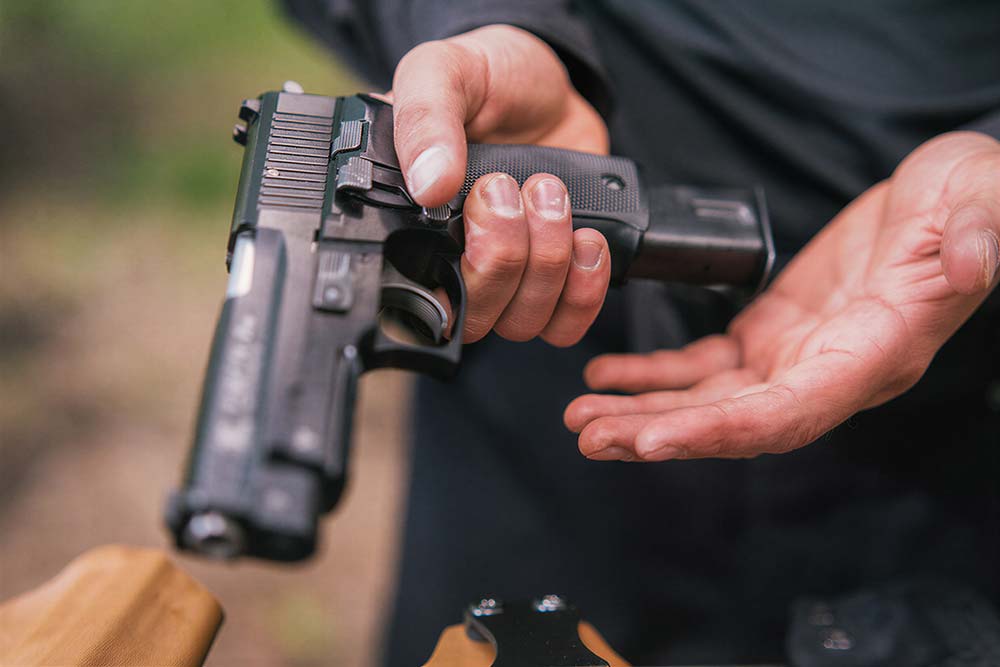
This is a dry-fire drill based on the reload portion of our Hi-Line Pistol Standard Course. It doesn’t require live ammunition, but it does require a safe dry-fire environment, appropriate dummy rounds or snap caps, and a proper target.
Drill parameters
- Distance: 7 yards
- Target: Torso/body scoring area
- Par time: 5.5 seconds
- Timer: Random start
- Equipment: Unloaded magazine-fed pistol, holster, spare training magazine, snap cap or dummy round, and shot timer
The sequence
- Begin from the holster with the pistol slide locked back and magazine inserted.
- On the timer’s signal, draw and simulate one shot to the body.
- Perform a speed reload using your spare training magazine, which contains one dummy round or snap cap.
- Complete the reload and simulate three additional shots to the body.
- Complete the sequence within 5.5 seconds.
The dummy round allows you to incorporate the action of chambering a round during the reload rather than simply exchanging empty magazines. Depending on your pistol and dry-fire equipment, you may need to reset the trigger or use a dedicated resetting training device to simulate multiple follow-up shots.
A note on safety: Remove all live ammunition from the practice area before starting. Physically and visually verify that the firearm and training magazines are free of live ammunition, use a designated safe direction with an appropriate backstop, and recheck your equipment if the session is interrupted. Never mix live and dummy ammunition during dry-fire practice.
What Are You Actually Practicing?
The obvious answer is the reload, but there’s more happening here than simply exchanging magazines.
You’re working on your draw, establishing an initial sight picture, making a deliberate trigger press, transitioning into the reload, and returning to an acceptable sight picture afterward.
All of those individual movements have to work together.
You may be perfectly comfortable drawing a pistol. You may also be pretty good at reloading one. But combining those skills against a timer can expose problems you wouldn’t notice practicing either movement independently.
That’s what makes the drill useful.
And while the 5.5-second par time provides a measurable standard, I wouldn’t recommend sacrificing safe handling or consistent technique just to beat the clock. If you’re struggling, slow things down, identify where the problems are occurring, and work on those individual movements.
Then put everything back together and see what happens.
Don’t Just Practice Until You Get It Right
After those first ten or so repetitions, I was starting to make the time. Not every time, but often enough to know I was getting back into the rhythm of the drill.
That’s progress, but it’s also worth remembering how I performed when I first started.
After all, I didn’t get ten warm-up attempts before my first cold run.
This is one of the reasons I believe in revisiting familiar drills regularly rather than assuming that a skill is still there simply because you’ve trained it before.
Dry fire gives us an opportunity to work on many of these skills without heading to the range, spending money on ammunition, or setting aside an entire afternoon.
And it doesn’t have to be a marathon training session. A few focused repetitions, performed safely and with some attention to what you’re actually doing, can tell you quite a bit.
Just don’t confuse getting better during a practice session with already being proficient when you started.
Next time you pull out your pistol for dry-fire practice, try running one of your familiar drills cold. Record the result, practice the skill, and then come back to it after some time away.
You might be surprised by how much difference there is.